Problem Statement
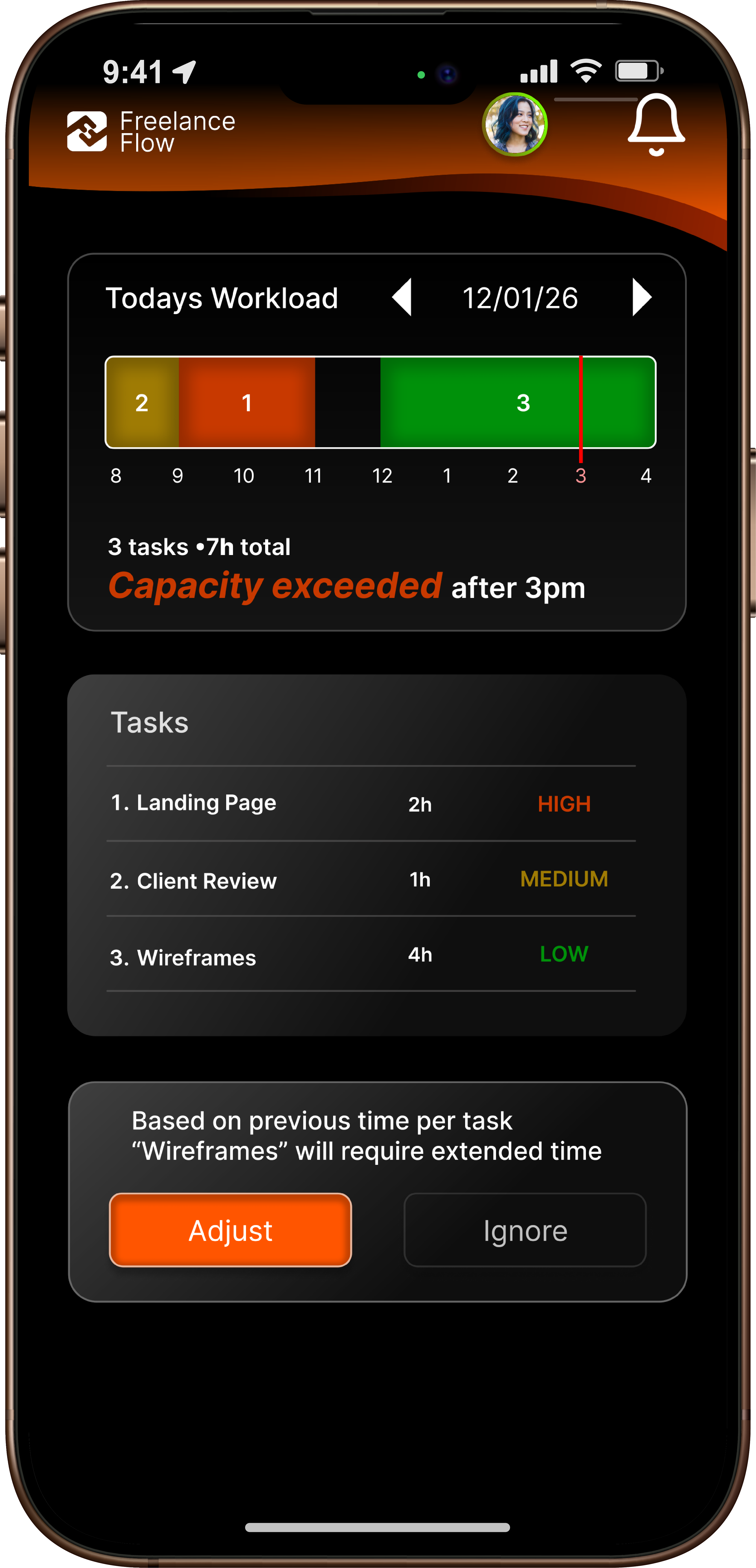
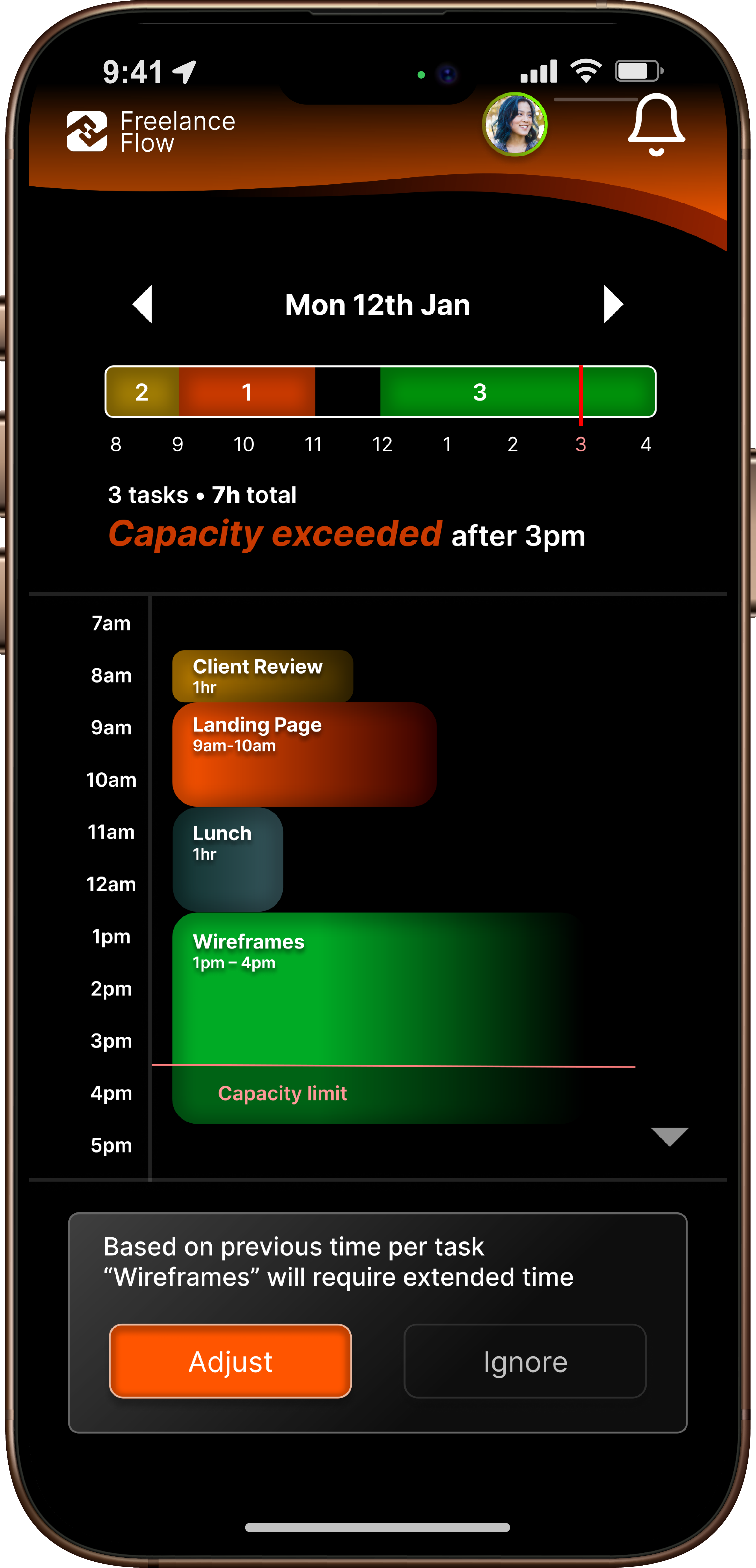
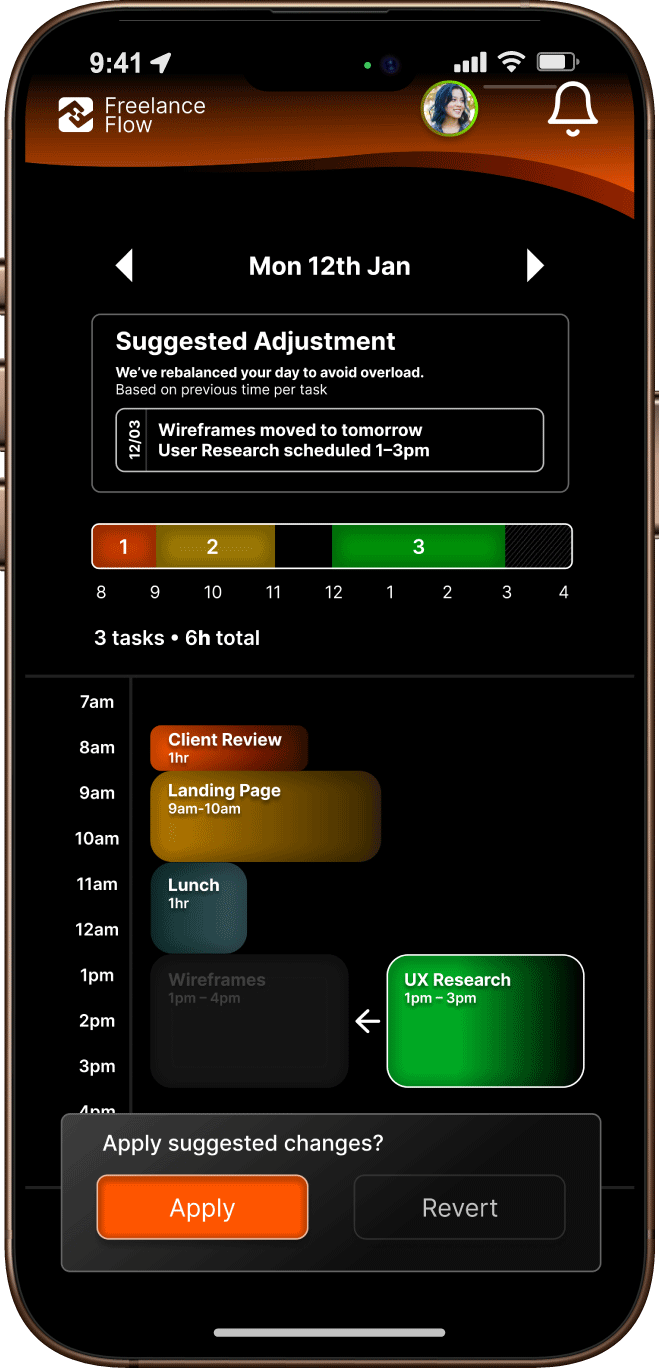
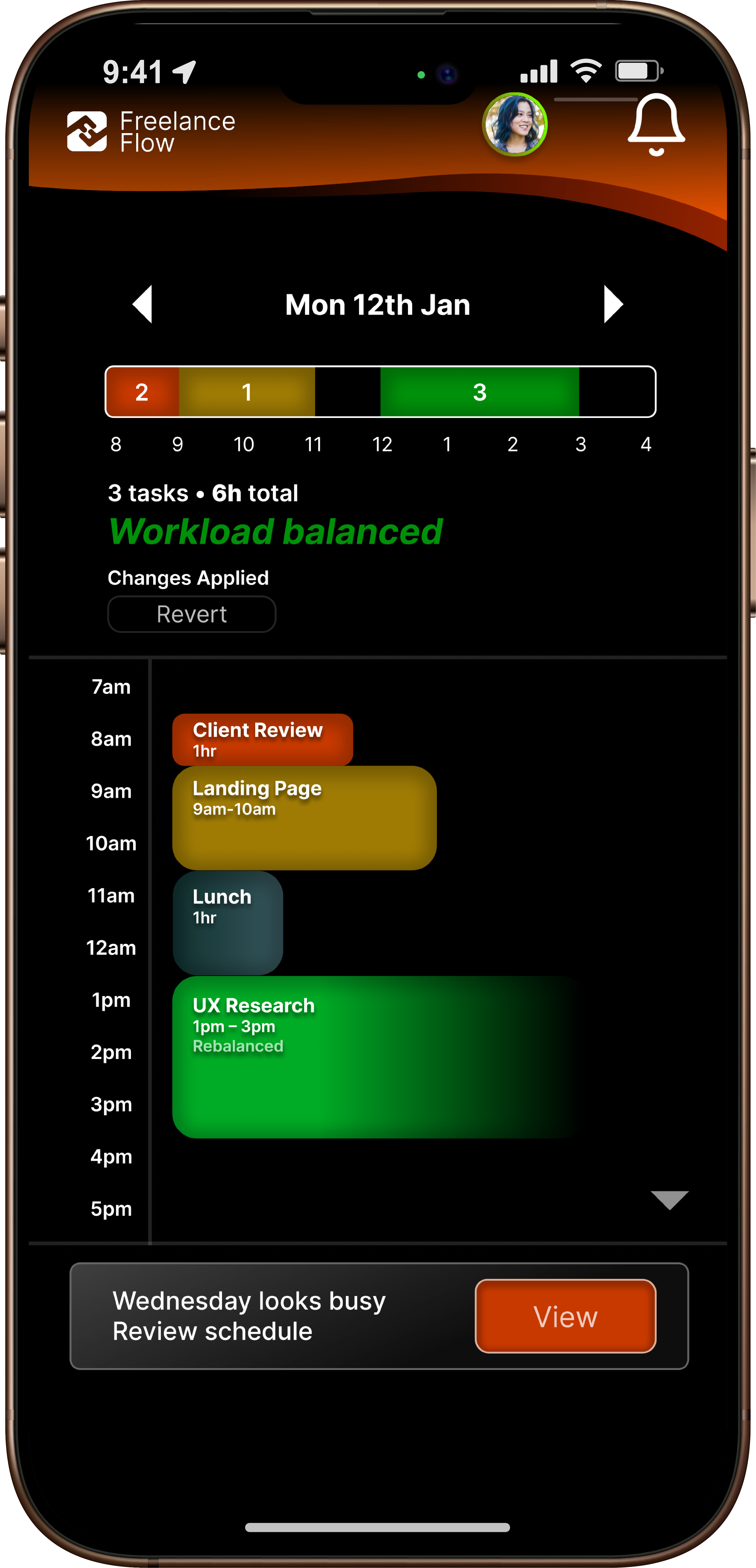
Freelancers often rely on a fragmented ecosystem of tools: calendars, task managers, email, invoicing software, and spreadsheets. While these tools work independently, they fail to provide a holistic understanding of workload and time capacity.
From initial research, several recurring issues emerged
Difficulty estimating how long tasks actually take
Overlapping deadlines across different clients
Constant context switching between tools
Manual scheduling and re-scheduling when priorities change
Increased stress due to lack of visibility into future workload
Existing tools focus on organisation, but very few help freelancers think ahead or adapt when plans change.
User Interviews
Exploratory User Interviews
Session length: 20 minutes each
Method: structured interviews
Participants: Freelancers working across design, development, and writing
Goal: Understand scheduling behaviour, pain points, and attitudes toward AI support
Participant 1
Freelance UX Designer
Experience: 5 years freelancing
Clients: 4–6 concurrent
Primary tools: Google Calendar, Notion, Gmail
Notes
Starts every day by checking Google Calendar, then mentally prioritises tasks.Uses Notion for task lists but does not time-block tasks accurately.Regularly underestimates how long design work takes, especially when feedback cycles are involved.
Finds it difficult to judge whether a day is “too full” until it is already underway.
Often works late to compensate for poor earlier planning.
Has tried productivity tools but abandoned them due to complexity.
Key Takeaway
Designers plan optimistically and rely heavily on intuition rather than data when scheduling.
Participant 2
Freelance Software Developer
Experience: 8 years contracting
Clients: 2–3 long-term clients
Primary tools: Outlook Calendar, Jira, Email.
Notes
Schedules meetings carefully but underestimates development tasks.
Feels calendars are good for meetings but useless for “deep work.”Uses rough time estimates but rarely revisits them.
Experiences sudden overload when multiple clients request changes at once.Often realises too late that deadlines conflict.Manually reschedules tasks when problems arise.
Attitude toward AI
Skeptical but curious.Would use AI if it saves time and reduces mental load.Strong preference for suggestions over automation.
“I don’t need AI to code for me, I need help seeing problems before they happen.”
Key Takeaway
Technical freelancers want predictive insight, not automation.
Participant 3
Freelance Content Writer
Experience: 3 years freelancing
Clients: 6–8 short-term clients
Primary tools: Todoist, Google Docs, Email.
Notes
Works off a daily to-do list rather than a calendar.Often accepts more work than realistically fits into a day.Finds it hard to balance urgent requests with planned writing time.
Experiences stress when multiple deadlines cluster together.Uses gut feeling rather than data to plan workload.Admin tasks (emails, invoicing) are often delayed.
Attitude toward AI
Very open to AI assistance.Particularly interested in AI help for admin and planning.Wants to retain editorial control over communication.“I don’t know I’m overloaded until I feel overwhelmed.”
Key Takeaway
Writers struggle with visibility into workload intensity and benefit from early warnings.
Participant 4
Freelance Digital Marketer
Experience: 6 years freelancing
Clients: 3–5 ongoing clients
Primary tools: Asana, Google Calendar, Slack.
Notes
Uses multiple tools but finds them fragmented.Relies on Asana for tasks, Calendar for meetings, Slack for communication.Switching between tools causes loss of context.
Schedules work weekly but constantly re-plans.
Frustrated by tools that require manual upkeep.
Attitude toward AI
Previously tried an AI scheduling tool but stopped using it. Lost trust when AI made changes without explanation. Would reconsider AI if transparency was improved.
“If a tool changes my schedule, I need to know why, otherwise I stop trusting it.”
Key Takeaway
Lack of explainability is a major barrier to AI adoption.
.png)
Insight 1
Planning breaks down because freelancers estimate work optimistically, not realistically
Insight statement:
Freelancers plan their schedules optimistically because they rely on intuition rather than historical effort, which results in overloaded days and frequent schedule breakdowns.
Clusters feeding this insight:
Optimistic planning & poor time estimationReactive scheduling & late conflict discovery
Why this matters:
The problem is not a lack of tools, but a lack of realistic forecasting. Any solution that doesn’t address estimation will fail.
Insight 2
Existing tools show time and deadlines, but not workload or capacity
Insight statement:
Freelancers struggle to assess whether a day or week is manageable because current tools show when work happens, but not how demanding it is, leading to invisible overload.
Clusters feeding this insight:
Lack of workload & capacity visibility Tool fragmentation
Why this matters:
Users cannot make good decisions without understanding effort. Visibility into workload intensity is more valuable than another task list.
Insight 3
Scheduling problems are discovered too late, forcing reactive replanning
Insight statement:
Freelancers often discover conflicts only after work has begun because tools lack early warning signals, resulting in constant reprioritisation and stress.
Clusters feeding this insight:
Reactive scheduling & late conflict discovery Cognitive load & decision fatigue
Why this matters:
Late discovery increases stress and reduces trust in planning tools. Early detection is a key opportunity for meaningful assistance.
Insight 4
Fragmented tools increase cognitive load by forcing users to connect information mentally
Insight statement:
Freelancers experience decision fatigue because planning information is spread across multiple tools, requiring them to mentally synthesise schedules, tasks, and communication.
Clusters feeding this insight:
Fragmented tool ecosystem Cognitive load & decision fatigue
Why this matters:
The mental effort of “connecting the dots” is a hidden cost. Centralisation is about reducing thinking, not adding features.